

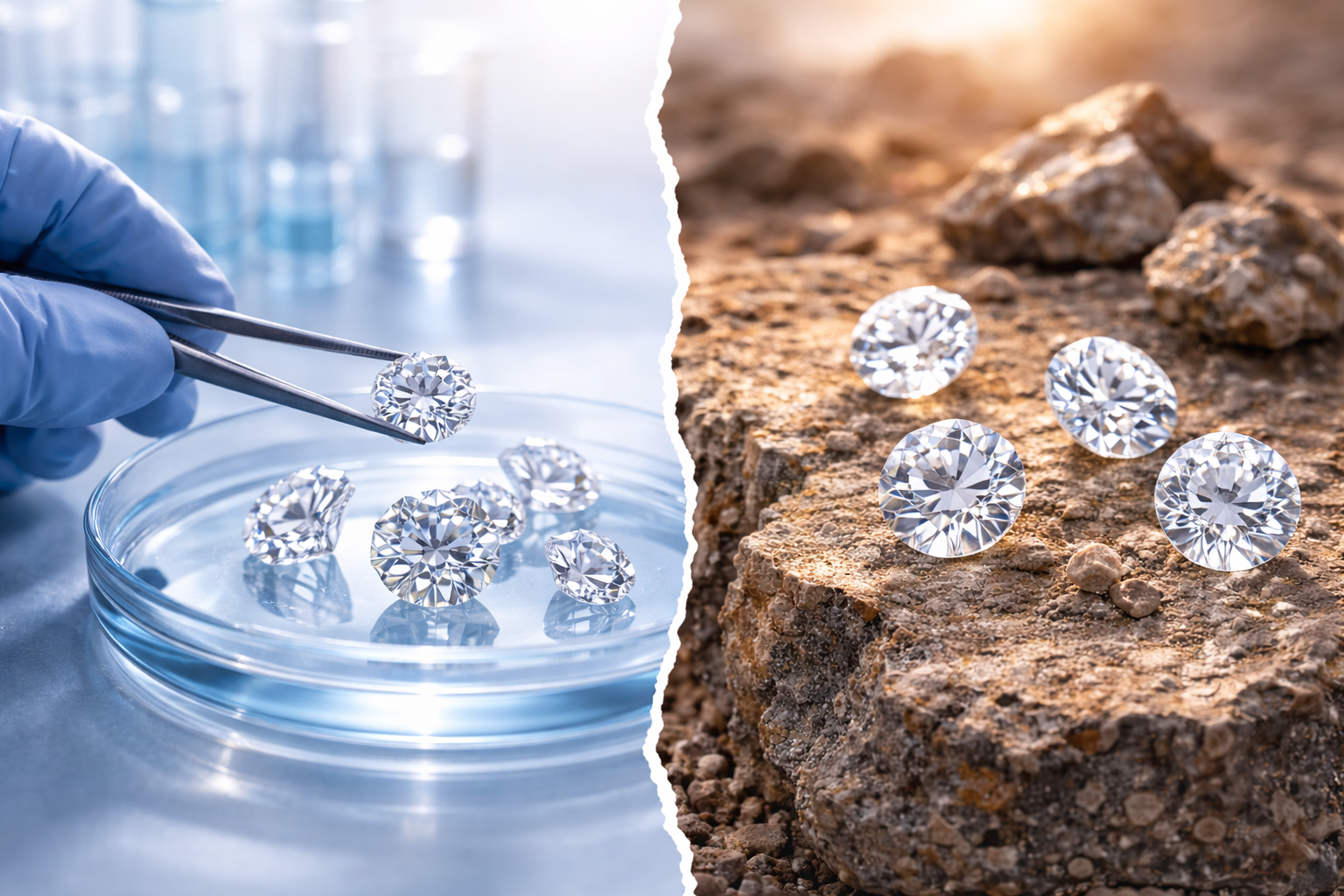
Quick Comparison Snapshot
Shopping for a diamond means navigating a genuinely important choice between lab grown and natural — one that affects your engagement ring budget, your values, and the story behind the stone. When you place diamonds side by side, both look identical, both are real, and both come with a diamond grading report. So what actually separates them?
Key differences at a glance:
- Origin — natural diamonds are formed deep in the earth over billions of years; lab-grown diamonds are produced in weeks under controlled conditions
- Cost — lab grown diamond prices sit 30–80% below comparable natural stones; lab diamonds cost less than natural diamonds at every carat weight
- Resale — natural diamond investment value holds better; lab grown diamond depreciation after purchase is steep
- Ethics — conflict free diamonds and ethical diamonds exist in both categories, but lab grown offers clearer supply chain transparency
For buyers already committed to a lab grown diamond ring but overwhelmed by options, Arden Fine has built their entire approach around solving exactly that — curating only the most popular, enduring designs on Amazon so the choice between lab grown and natural translates effortlessly into a ring she'll love.
What Are Lab-Grown vs Natural Diamonds?
Are Lab-Created Diamonds Real Diamonds — or Something Else?
Are lab-grown diamonds real diamonds? The FTC guidance on diamond marketing terms answers unambiguously: yes. Lab grown diamonds are real diamonds — not simulants like cubic zirconia or moissanite, which are chemically distinct diamond alternatives that merely resemble diamonds. Lab-grown diamonds are chemically, physically, and optically identical to natural diamonds. Both score 10 on the Mohs hardness scale, share the same refractive index and brilliance, and carry full diamond certification GIA IGI. The type of diamond differs in origin only — lab-grown diamonds don't carry a geological story, but diamonds are identical in every measurable physical sense.
Natural Diamonds Form vs Lab Created Diamonds: The Core Difference
According to diamond 4Cs grading explained by the GIA, natural and lab-grown diamonds are evaluated using identical grading standards — which is precisely why buyers struggle to tell the difference between the two.
Natural diamonds are formed 100+ miles beneath the earth under natural conditions of extreme heat and pressure over billions of years. Each mined diamond is a heirloom quality diamond — geologically unique and irreproducible. Whereas natural diamonds take geological time, lab-grown diamonds are produced in controlled environments replicating those same natural conditions, delivering stones identical to natural diamonds in weeks. The difference between lab creation and natural formation is one of time and origin — not quality. Lab-grown diamonds don't have a billion-year story, but their natural counterpart has no optical or physical advantage because of it.
The Way Diamonds Are Created
HPHT and CVD Diamond Creation: How Diamonds Are Grown in a Lab
Diamonds can be created in a lab via two primary methods:
HPHT diamonds place a rough diamond carbon seed under temperatures exceeding 1,300°C and pressures above 1.5 million PSI — replicating the natural conditions under which diamonds crystallize. Carbon builds around the seed in weeks, producing stones known for exceptional D–F color grades.
CVD diamonds grow a lab-grown diamond layer by layer in a gas-filled chamber. CVD diamonds tend to be nitrogen-free — a key gemological identifier — and are widely favored for eco friendly engagement ring stones. Since lab grown CVD production requires lower energy per carat, it represents one of the more sustainable diamond options available today.
How Natural Diamonds Form vs How Lab-Grown Diamonds Are Made
Natural diamonds typically form under extreme geological pressure over billions of years, surfacing through kimberlite volcanic pipes. Responsible mining operates under the official Kimberley Process conflict-free standard, tracking mined diamonds from source to market. Each carries a diamond origin report no diamond grown in a lab can replicate. Diamonds are grown in a lab in weeks; natural diamonds often take a billion years or more. Both produce diamonds that are chemically and structurally identical — the difference between lab and natural formation is entirely one of time.
Lab-Grown Diamonds Real vs Natural.
Lab-grown diamonds and natural diamonds are visually indistinguishable to the naked eye — even diamonds side by side look identical without specialized tools. Differences require advanced equipment:
- Diamond inclusions — natural diamonds often contain mineral inclusions from their geological journey; lab-grown diamonds may show metallic flux inclusions (HPHT) or cloud-like features (CVD)
- Nitrogen in diamonds — natural diamonds typically contain trace nitrogen; CVD diamonds are usually nitrogen-free, detectable only with spectroscopy
- Diamond fluorescence — lab-grown diamonds and natural diamonds both exhibit diamond fluorescence under UV light
- Diamond origin report — certification states whether the stone was created in a lab or mined, with a laser-inscribed diamond grading report number on the girdle
- Lab-Grown Diamonds and Natural Diamonds: Appearance Side by Side
Diamonds are identical in appearance regardless of origin. A lab-grown diamond engagement ring placed next to one set with a mined diamond is visually indistinguishable. Both receive identical grades across the diamond 4Cs — cut, color, clarity, and carat — with full diamond certification GIA IGI. Lab-grown diamonds offer one compelling advantage: because lab grown diamond prices are dramatically lower, buyers can access larger, higher-grade stones within the same engagement ring budget. The diamond made in a lab may actually appear more impressive than its natural counterpart at the same price point.
This is the insight behind Arden Fine's curatorial approach — selecting only the lab grown diamond jewelry that genuinely performs beautifully in real life, making the choice between lab grown and natural simple, not stressful.
Do Lab Diamonds Cost Less Than Natural Diamonds — and Why?
Lab-grown diamonds are produced at increasing scale — which is why diamonds cost less than natural diamonds when grown in a lab. Natural diamonds are still subject to finite geological supply and costly extraction, sustaining their price on the natural diamond market.
- A 1ct, G-color, VS1 natural diamond retails for $6,000–$8,000; the lab-grown diamond equivalent: $1,200–$2,000
- Lab grown diamond prices in 2026 have continued falling as HPHT diamonds and CVD diamond production scales globally
- Since lab grown supply is unlimited, the price difference widens at larger carats — giving buyers access to statement stones previously beyond reach on a typical engagement ring budget
Lab vs Natural Diamond: Resale Value and Long-Term Investment
Diamond resale value is where the difference between lab and natural diamonds is most consequential:
- Natural diamond investment value holds at roughly 40–60% of retail — a mined diamond retains meaningful value on the natural diamond market
- Lab grown diamond depreciation is steep — diamonds are still being produced in increasing quantities, eroding secondary market value further
- Natural diamonds typically hold value better because geological rarity cannot be replicated — whereas natural diamonds are finite, diamonds created in a lab are not
- A $6,000 heirloom quality diamond might resell for $2,500–$3,500 in five years; a $1,500 lab-grown diamond equivalent might recover very little
Are lab diamonds worth it? If long-term value matters, natural holds a meaningful edge. If you want the most impressive stone within your engagement ring budget — more carat, more clarity, more cut quality — lab-grown diamonds offer extraordinary value. Neither answer is wrong.
Lab or Natural Diamond for an Engagement Ring: Which Is Right for You?
Lab Grown or Natural: Sustainability, Ethics, and Mined Diamond Considerations
Lab-grown diamonds and natural diamonds have both made progress on ethics — but the difference between the two is real:
- Lab grown diamonds vs mined diamonds — lab grown avoids land disturbance, reduces environmental footprint, and offers complete traceability; a genuine eco friendly engagement ring choice
- Diamonds are produced in labs with increasingly renewable energy, strengthening sustainable diamond options credentials
- Natural diamonds often support local mining economies and, certified under the Kimberley Process, are conflict free diamonds
- Lab-grown diamonds offer clearer supply chain transparency; whereas natural diamonds require more trust in certification systems like Kimberley Process certification
Lab vs Natural Diamonds: Simple Decision Guide
Choose lab grown if you:
- Want maximum size and quality within your engagement ring budget
- Prioritize sustainable diamond options and supply chain transparency
- Want a diamond without the rarity premium — a diamond engagement ring that looks exceptional for less
- View the ring as a symbol, not an investment
Choose natural if you:
- Value natural diamond investment value and long-term diamond resale value
- Want a heirloom quality diamond with an irreproducible geological story
- Are willing to pay the price difference for rarity and significance on the natural diamond market
Arden Fine was built for buyers who have made their choice — and now want to act on it simply and confidently. Their curated lab grown diamond ring collection on Amazon presents only the finest, most customer-loved designs. No decision fatigue. No showroom pressure. Just clarity — the same editorial confidence you'd expect from a trusted diamond jeweler NYC, delivered online.
FAQs: Lab-Grown Diamonds vs Natural — Everything You Need to Know
Are lab grown diamonds as good as natural diamonds? Diamonds are identical in beauty, hardness, and diamond 4Cs grading. Lab-grown diamonds are chemically and optically the same as natural ones — the only real differences are origin, price, and diamond resale value.
Do lab grown diamonds hold value like natural diamonds? No. Lab grown diamond depreciation is significant. Natural diamond investment value holds considerably better on the natural diamond market over time.
Can a jeweler tell if a diamond is lab grown? Not with the naked eye. Even diamonds side by side look identical. Specialized equipment analyzing diamond inclusions, nitrogen in diamonds, and growth patterns is required to tell the difference between lab and natural diamonds.
Do lab grown diamonds test as real diamonds? Yes. Lab grown diamonds are real diamonds — standard testers confirm this because diamonds are chemically identical whether grown in a lab or mined.
Are lab grown diamonds more ethical? Lab-grown diamonds offer greater transparency and lower environmental impact. However, conflict free diamonds certified under the Kimberley Process are equally ethical diamonds — the difference between the two depends on specific sourcing.
Lab and Natural Diamonds — Choosing the Real Diamond That's Right for You
The difference between lab-grown and natural diamonds is real — but it's not about quality, beauty, or whether lab-grown diamonds are real diamonds. It's about origin, diamond resale value, and what the stone means to you.
Lab-grown diamonds and natural diamonds are both real. Both certified. Both capable of anchoring a stunning diamond engagement ring. The price difference is significant. The visual difference — even diamonds side by side — is nonexistent. The emotional difference is entirely personal.
Choose with clarity. Arden Fine's curated collection of lab grown diamond rings on Amazon exists for exactly this moment — helping buyers find the piece that truly matters, without the overwhelm. A diamond engagement ring chosen with intention will always be the right one.


